
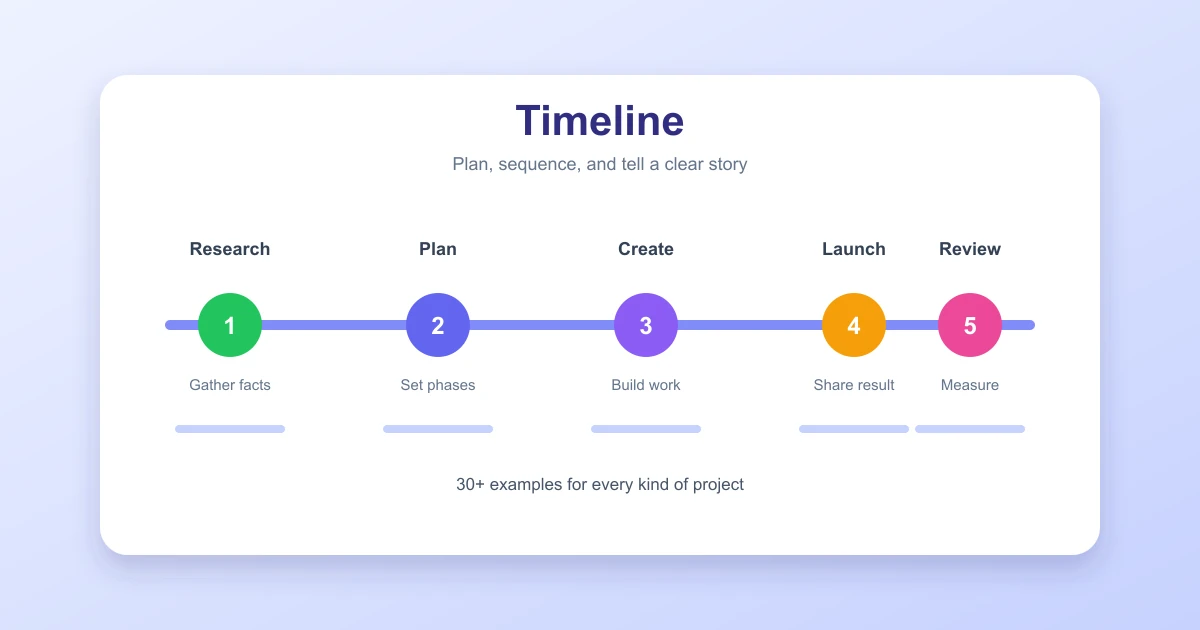
A timeline turns dates, phases, milestones, and progress into an ordered visual story. It works for project planning, company history, research, lesson plans, resumes, campaigns, and personal goals.
Quick answer
The best timeline matches the story you need to tell. Choose a horizontal timeline for a compact sequence, a vertical timeline for longer lists, a roadmap for planned work, and a Gantt style schedule for overlapping tasks and dependencies.
Common timeline formats
Horizontal timeline
A horizontal timeline places milestones along a left to right line. It fits company milestones, meeting agendas, historical phases, and presentations with a wide canvas.
Vertical timeline
A vertical timeline stacks events from top to bottom. It is useful for detailed histories, biographies, article summaries, and mobile pages.
Roadmap timeline
A roadmap groups future work into phases or quarters. Product roadmaps, marketing plans, campaign schedules, and strategic plans often use this format.
Project schedule timeline
A schedule timeline shows start dates, end dates, dependencies, and ownership. Gantt charts and swimlane layouts are common choices for complex work.
Circular timeline
A circular timeline presents a repeating cycle. It can show annual seasons, recurring processes, development stages, or a loop that returns to its starting point.
Snake timeline
A snake timeline changes direction across rows. It works for more milestones than a single line can hold without making text cramped.
30+ timeline examples
| Use case | Timeline type | Main information |
|---|---|---|
| Product launch | Marketing roadmap | Prelaunch, launch, and promotion phases |
| Company history | Horizontal or vertical | Founding, funding, products, and milestones |
| Project plan | Gantt schedule | Tasks, dates, owners, and dependencies |
| Career resume | Vertical career timeline | Roles, employers, education, and achievements |
| Historical event | Dated vertical timeline | Events, locations, and sources |
| Book or film plot | Story arc | Key scenes and turning points |
| Construction project | Construction schedule | Permits, foundations, building, and handoff |
| Software release | Release roadmap | Versions, testing, launch, and maintenance |
| Wedding planning | Countdown roadmap | Venue, guests, attire, ceremony, and reception |
| Employee onboarding | Process timeline | Day 1, week 1, month 1, and performance reviews |
| Content calendar | Editorial roadmap | Topics, publishing dates, channels, and owners |
| Research study | Research schedule | Planning, recruitment, collection, analysis, report |
| Supply chain | Event timeline | Order, production, shipment, customs, delivery |
| Legal case | Evidence timeline | Events, filings, hearings, and decisions |
| School lesson | Learning sequence | Introduction, activities, review, assessment |
| Fitness program | Training schedule | Baseline, training blocks, recovery, tests |
| Travel itinerary | Daily vertical timeline | Flights, stays, attractions, reservations |
| Social campaign | Campaign calendar | Teasers, posts, events, reporting |
| Medical process | Patient journey | Symptoms, care, treatment, follow-up |
| Climate data | Annotated time series | Changes, events, measurements, sources |
| Website redesign | Process roadmap | Audit, wireframes, build, testing, launch |
| Movie production | Production schedule | Development, filming, editing, release |
| Annual review | Monthly highlight line | Revenue, goals, launches, lessons |
| Product development | Stage gate timeline | Idea, design, prototype, test, scale |
| Fundraising campaign | Campaign roadmap | Target, outreach, events, final appeal |
| Personal savings goal | Goal progress timeline | Starting amount, deposits, milestones, target |
| Event day | Schedule timeline | Registration, sessions, breaks, closing |
| Incident response | Log timeline | Detection, containment, recovery, review |
| House renovation | Remodel schedule | Design, contractors, work, inspection |
| Project retrospective | Event and decision timeline | Successes, delays, decisions, lessons |
| Market evolution | Industry timeline | Technology, competitors, regulation, adoption |
Timeline template ideas
Copy one of these structures, then replace placeholder dates and descriptions with verified information.
- Three phase roadmap: Now, next, and later columns with two milestones in each phase.
- Weekly schedule: Seven rows and one colored task bar per responsible owner.
- Vertical biography: One dated milestone per row with a short summary and relevant image.
- Project Gantt chart: Task names on the left, calendar intervals across the top, and owners in each bar.
- Customer journey: Awareness, consideration, purchase, onboarding, and retention stages.
- Historical timeline: Date, place, event, result, source, and optional image for each entry.
Timeline design checklist
- Write the central takeaway before adding dates.
- Choose chronological, planned, or relative time, and keep the method consistent.
- Label units clearly, especially if different entries cover different durations.
- Use a common scale when distance between points represents time.
- Give important milestones visual weight without hiding supporting events.
- Add dates in a readable format and check time zones or calendar conventions.
- Cite historical or research data near each group that uses it.
- Test the layout on desktop and mobile, then keep a text alternative available.
Common questions
How many dates should a timeline include?
Include only dates that support the main message. Group minor details or move them to an expandable list when the timeline becomes crowded.
What is the difference between a timeline and a roadmap?
A timeline records events in sequence, including past events. A roadmap primarily plans future work and often groups deliverables into phases.
Can a timeline use images?
Yes. Small images can identify people, places, products, or events. Keep image size consistent and add alt text for images used on a web page.
Which timeline template works best for projects?
Use a Gantt timeline for overlapping tasks and dependencies. A simple roadmap is easier to scan when audiences mainly need phases and planned outcomes.
Bottom line
Simple takeaway
Start with the story, choose a timeline format that fits its sequence, and remove dates that do not support the message. Clear labels, consistent spacing, and accurate sources will make the result useful in reports, presentations, websites, and print materials.